Blask Weekly Digest: Brazil’s demand drops to 2022 levels
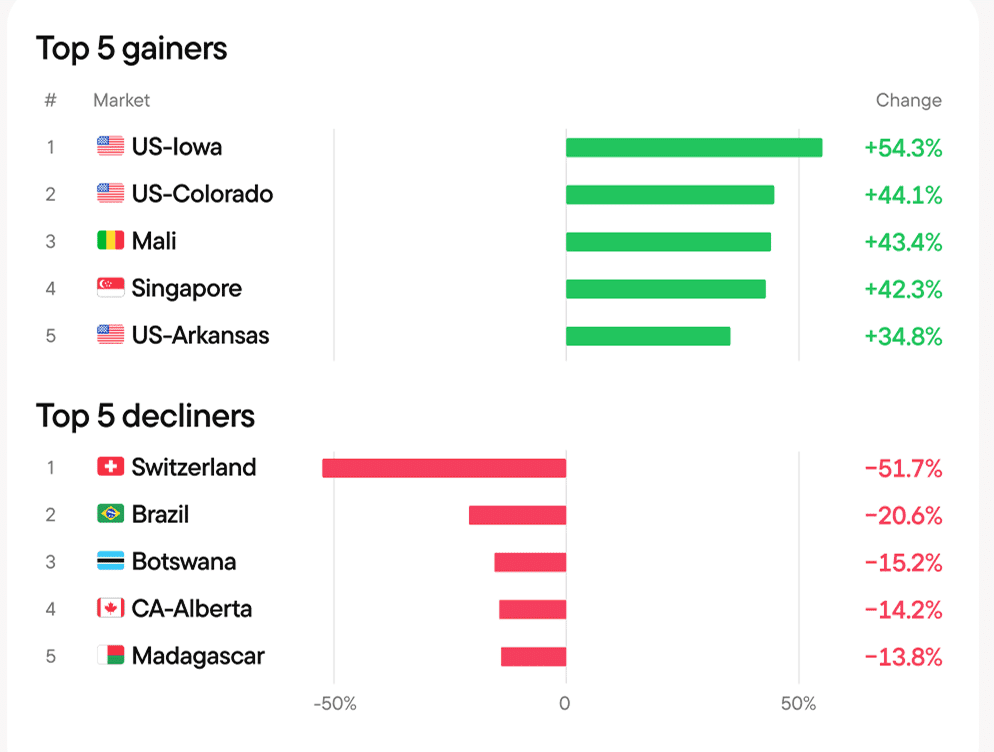
This week’s Blask Index shows Iowa led the gainers with a 54.3% increase, followed by Colorado (+44.1%), Mali (+43.4%), Singapore (+42.3%) and Arkansas (+34.8%). On the other side, Switzerland saw the steepest drop at 51.7%, ahead of Brazil (-20.6%), Botswana (-15.2%), Alberta (-14.2%) and Madagasc…
This week’s Blask Index shows Iowa led the gainers with a 54.3% increase, followed by Colorado (+44.1%), Mali (+43.4%), Singapore (+42.3%) and Arkansas (+34.8%). On the other side, Switzerland saw the steepest drop at 51.7%, ahead of Brazil (-20.6%), Botswana (-15.2%), Alberta (-14.2%) and Madagascar (-13.8%). Brazil’s decline comes as the country’s regulated betting market went offline under Provisional Measure 1,394. Top 5 gainers and decliners of the week Brazil’s betting demand is back to September 2022 levels: 3 Fridays show how it got there Brazil’s Blask Index stood at 155.3 million in September 2026, almost exactly where it was in September 2022 (158.7 million). Getting there did not take 4 years but 4 months, and the final drop happened in three weeks. The betting ban did not arrive as one cliff. Blask Index shows it as a staircase, and the clearest way to see it is to compare three consecutive Fridays: the day the decree was signed, the Friday after, and the Friday after that. Friday 25 September: the decree. President Lula signed Provisional Measure 1.394 and new deposits were closed. Brazil’s Blask Index that day was 5.71 million: 5.41 million for local operators (94.83%) and 294.9 thousand for international ones (5.17%). It was already 20% below an average pre-ban Friday, but the market still looked like a licensed one. Saturday 26 September: the spike. The next day demand jumped 41% to 8.05 million, the highest day of the period. Local operators reached 7.55 million (93.83%), international 496.5 thousand (6.17%). The jump was news-driven: people searched for the brands that had just been banned. Within 24 hours it was gone: on Sunday local demand was 3.41 million and international 405.2 thousand, with the international share at 10.63%. Friday 2 October: a week later. The index stood at 1.24 million. Local operators: 959 thousand. International: 282 thousand. In one week the total fell 78% from the decree day, local demand fell 82%, and international demand barely moved (−4%). The international share was 22.7%. Friday 9 October: the third Friday, after licensed sites went offline on 6 October. The index was 1.01 million. Local: 725 thousand. International: 283 thousand, practically the same as a week earlier. The total was 19% below 2 October and 82% below the decree day. International share: 28.1%. The pattern is simple. Local demand collapsed in two steps. International demand did not grow: it stayed at around 280–295 thousand across all three Fridays. Its share rose from 5% to 28% because the rest of the market disappeared. Brazil’s monthly Blask Index peaked in April and May 2026 at about 240 million, and the trend has been falling since May. It fell every month after: 236 million in June, 192 million in July, 170 million in August and 155 million in September, 35% below May. September 2026 is now almost exactly at the level of September 2022 (158.7 million). And September includes only the first days of the ban, so October will be lower. In the week of 5–11 October the index was at its lowest weekly level since July 2021, and 9 October was the lowest Friday since July 2021. FanDuel challenges Bet365’s global lead as gap narrows by 53% in Q3 2026 Blask data shows that Bet365 retained its position as the world’s leading iGaming brand by projected revenue in Q3, but FanDuel briefly overtook it in September. The global top 10 remained almost unchanged. Bet365 held on to first place in Blask’s global Competitive Earning Baseline (CEB) ranking for Q3 2026, but its lead over FanDuel narrowed significantly. CEB (Competitive Earning Baseline) is Blask’s estimate of potential operator revenue, rather than reported financial results. Blask reports CEB as a range: a lower bound (min), a central estimate (avg) and an upper bound (max). The ranking below is based on the central estimate, and the full ranges are shown in the table. The gap between the two operators in the central estimate fell from $102 million in Q2 to $48 million in Q3, a reduction of approximately 53%. Both brands lost revenue potential quarter-on-quarter: Bet365 by 8.0% and FanDuel by 5.6%, so the narrowing came mostly from Bet365’s decline. In September, FanDuel moved ahead of Bet365 for the first time in the six-month comparison period, recording $651 million in projected revenue (range: $488 million to $1.14 billion) against Bet365’s $619 million (range: $444 million to $1.14 billion). The September result marked a shift at the top of a ranking that otherwise showed remarkable stability. Global iGaming market reaches $59.1 billion in projected revenue According to Blask, the global iGaming market’s CEB reached $59.1 billion in Q3 2026 (range: $36.9 billion to $125.8 billion), down 2.1% from the previous quarter. The world’s 10 leading operators accounted for approximately 22% of the central estimate, compared with 22.5% in Q2. Despite the overall quarterly decline, the leading brands largely maintained their positions. DraftKings grows as competition tightens While Bet365 and FanDuel competed for first place, DraftKings was the only operator among the top four to record quarterly CEB growth (+1.3%). Its gap with third-placed Bovada narrowed from $201 million in Q2 to $89 million in Q3. Betano maintained fifth place, increasing its CEB by 4% quarter-on-quarter. The first seven brands finished Q3 in exactly the same order as Q2. Other notable changes included: Rainbet: CEB declined 14%, the sharpest percentage drop among the top 10. 1xBet: Overtook Stake, reversing a $7 million deficit in Q2 into a $20 million lead in Q3. Bet365 and FanDuel: Remained first and second respectively for the full quarter, despite September’s reversal. What the ranking reveals The Q3 results suggest that competition among the world’s largest iGaming brands is intensifying without significantly changing the overall ranking. Bet365 remains the leader on the central estimate, but FanDuel’s September performance shows how quickly the balance can shift between the two largest brands. DraftKings’ growth and Betano’s continued expansion provide further evidence that individual operators can gain ground even when the wider market contracts. The next quarter will show whether September’s reversal between Bet365 and FanDuel was temporary or the beginning of a more sustained change in the global ranking. Singapore’s iGaming demand surges 42% in a single week, Blask data shows Search interest for gambling brands jumped as the Singapore Premier League returned from the FIFA break; state operator Singapore Pools accounted for nearly all of the growth. Singapore’s iGaming demand rose 42.3% week on week (5–11 October), according to Blask Index data, with demand reaching 713,709 versus 501,550 the week before. The increase coincides with the return of the Singapore Premier League from the FIFA international break. Matchweek 3 of the 2026/27 season was played over the weekend, including Geylang International against FC Jurong on 10 October, billed as a meeting between the only two unbeaten sides, and Lion City Sailors against Young Lions and Tanjong Pagar United against Tampines Rovers on 11 October. State operator Singapore Pools, which offers sports betting, accounted for almost the entire increase. Its demand peaked on Friday 9 October, the day before the first weekend fixtures, at more than twice the previous day’s level, and stayed above the prior week’s average through Saturday and Sunday. Other brands tracked by Blask in Singapore showed no comparable movement. Blask Index is a real-time measure of market demand volume for iGaming brands in a given country, based on normalized search data. It reflects search interest, not revenue or player numbers, and the link to the football calendar is an inference from timing, not a proven cause. Stake’s Brazil reprieve is reversed within a day, but search demand jumped sixfold A federal appeals court suspended the injunction that let Stake Brazil keep operating until 25 October. Blask data shows demand for the brand rose about sixfold on 8 October, peaked on 9 October and fell back by 12 October. On 8 October 2026, a São Paulo federal court preserved the authorization of Stake Brazil Ltda. and unblocked stake.bet.br until 25 October. A day later, on 9 October, the president of the Federal Regional Court of the 3rd Region (TRF-3), Luis Antonio Johonsom di Salvo, suspended that injunction at the federal government’s request. Stake went back to the same position as every other licensed operator in the country: offline. The ban comes from Provisional Measure 1.394/2026. It required betting platforms to go offline within 10 days and ended existing authorizations after 30 days, on 25 October. The 8 October injunction rested on that gap between the two dates. Why the court reversed Stake’s exemption The appeals court did not rule on whether the ban is constitutional. It addressed the effect of the injunction: Stake would trade while every other licensed operator stayed closed. The court removed the exemption, so Stake is under the same restrictions as the rest of the regulated market. The injunction itself had also been narrow. Stake had asked to operate until its licence expires on 31 December 2029, and the São Paulo judge granted only until 25 October, with conditions. Stake had to keep withdrawals open and could not run promotions, bonuses or user-acquisition campaigns. The question of the ban’s legality is still open. Search demand for Stake rose sixfold in one day Blask’s daily Blask Index for Stake in Brazil sat between roughly 5K and 14K from 1 to 7 October. On 8 October, the day of the injunction, it rose to about 88K. It peaked on 9 October at about 99K, the day the injunction was suspended, and stayed near 89K on 10 October. Then it fell: to about 47K on 11 October and about 25K on 12 October. That is below the peak by three quarters but still above the 1–5 October level. Blask Index is a real-time measure of market demand volume for iGaming brands in a given country, based on normalized search data. Stake held 0.1% of Brazil’s demand before the ban Stake was a small brand in Brazil before the shutdown. In Blask’s September 2026 data it ranked 62nd of 512 tracked brands by BAP, with a 0.1% share. Betano led with 33.4%, followed by Bet365 (10.1%), Superbet (8.2%) and Sportingbet (6.0%). The market was concentrated among licensed operators. In September, licensed brands accounted for 94.7% of search demand (Blask Index) and offshore brands for 5.3%. On Blask’s Competitive Earning Baseline (CEB), a measure of projected revenue potential, licensed brands held 96.5% and offshore 3.5%. CEB is estimated over a rolling 12-month window and is not gross gaming revenue. What happens next The legal challenge to the ban is unresolved. The government has said it will appeal the São Paulo ruling, and the federal government has asked the Supreme Court to keep the ban in place. Brazil’s licensed market stays shut, and the next date to watch is 25 October, when existing authorizations end under the provisional measure. For Stake, the sequence ran from injunction to reopening to reversal in under two days. The search data shows the audience was still there throughout. Only the access changed. As of 12 October 2026, Stake Brazil had lost its temporary exemption and Brazil’s licensed betting market remained shut down.